
When handled by an expert, a machine is infinitely more stable than when handled by a novice. It is for this reason that machine control skills are a very important part of performance riding. In this Pro Guide we will look at stability and traction and in the next Pro Guides we will move on to discuss throttle control, steering and braking.
STABILITY AND TRACTION
Why do we need to understand about stability and traction?
The rider has a very significant influence on the stability of a bike and its ability to maintain traction. Learning how to optimise stability will enable the rider to use more of the bike’s potential, safely.
The importance of a light grip
The front wheel of the bike is designed to move freely and to follow the ‘command direction’ given by the rider. It behaves just like any castor wheel (such as found on a shopping trolley). When a shopping trolley is pushed around a corner, the front wheel adjusts to the exact track needed to take the trolley effortlessly through the manoeuvre. In the same way, a motorcycle front wheel oscillates freely, making continuous adjustments to optimise its track. On a bend, once the steering command is complete, the wheel ‘falls’ into alignment with the exact track it needs to follow for optimum stability. And it does this effortlessly, precisely and best of all, automatically.
However, the untrained rider can just as effortlessly spoil this precision action. When a rider grips the bars tightly, the wheel can no longer do its design job and stability is reduced. Worse still, when the stability is at its most critical, such as in a fast corner, the rider is most likely to be tight on the bars – and the bike’s natural stability is spoiled.
One of the fundamental skills a rider needs to master, and it is counter-intuitive, is to learn to keep a very light grip on the bars – especially in challenging situations.
How weight transfer and rough handling affects stability
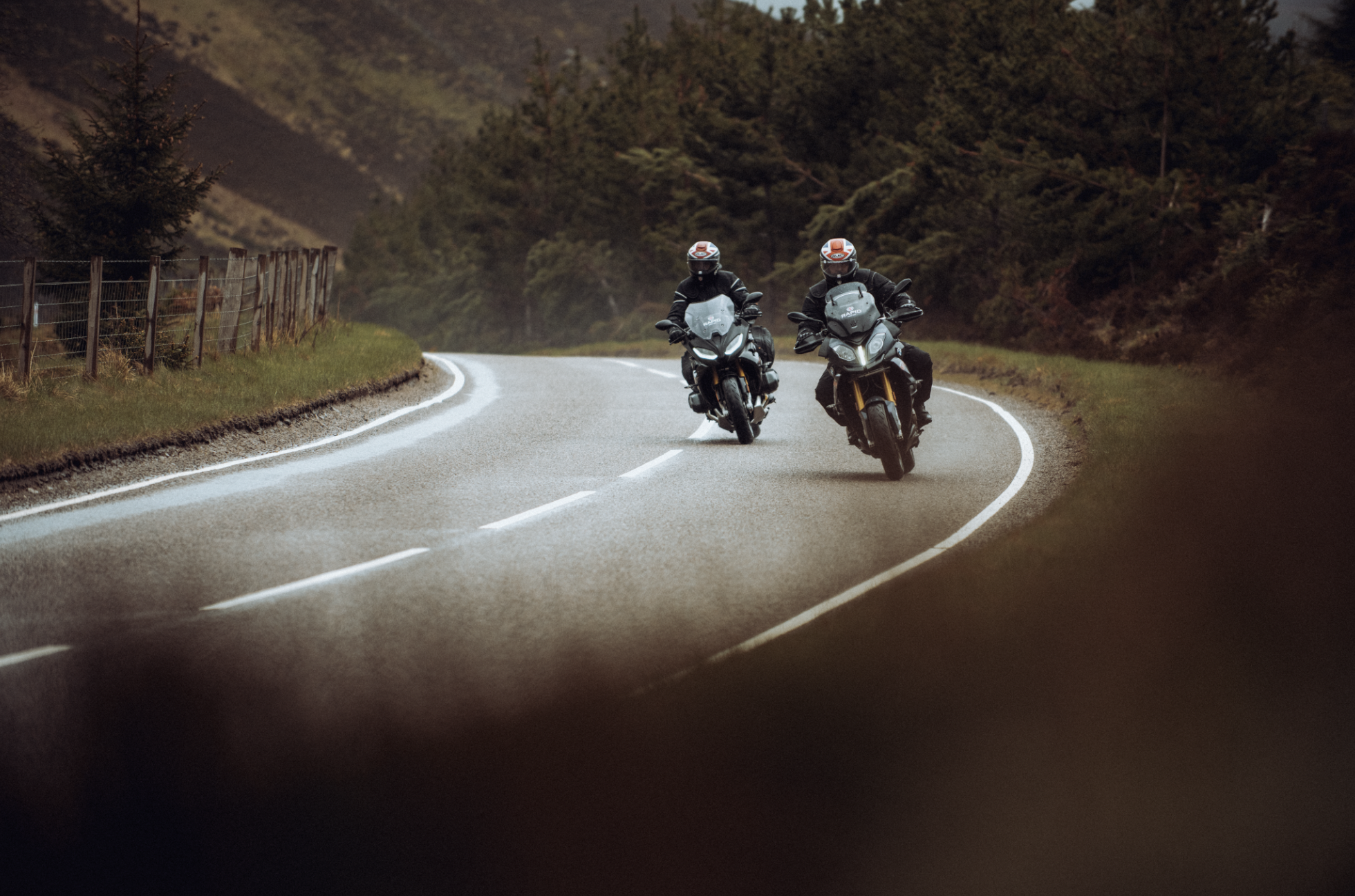
Under braking and acceleration, very considerable weight shifts happen on a bike. This has an impact on stability as it affects the grip on the front and rear tyre and the ability of the suspension to operate effectively to keep the tyres in contact with the road. Rough handling also reduces stability and can cause loss of traction. To prevent this, controls are always used smoothly and progressively and body weight, if moved around, is done smoothly.
Once again, a tight grip on the bars has a serious impact on both of these issues. Stiff arms allow rider weight to transfer dramatically onto the front wheel and suspension, potentially overloading it, and a tight grip affects our ability to operate the controls smoothly. Riders therefore need to practice braking, accelerating and steering with very relaxed arms to avoid this.
The key drivers of traction
To optimise riding performance, riders need to understand the basics of traction. In many cases, riders underestimate the effect they have on the ability of the bike to maintain traction. Traction is most strongly affected by weight and coefficient of friction and riders can have significant impact on both of these.
Weight
Increased weight causes the pressure between two surfaces to increase which in turn improves traction. Running a finger over any surface lightly, then again with heavy downward pressure demonstrates this.
We have already discussed the issue of weight transfer and seen that it is a feature of braking and acceleration. Braking shifts weight off the rear tyre thereby reducing traction, and onto the front tyre thereby increasing traction. Likewise, acceleration increases weight onto the rear tyre increasing traction, and off the front tyre decreasing traction.
Rider inputs therefore have a big impact on stability and traction. The section on throttle control and braking will highlight this.
Coefficient of Friction
This is the friction properties of the surfaces in contact with each other (road and tyre). The ‘stickier’ they are, the more grip is available. It is affected by the tyre choice and condition, and the road surface qualities.
The rider can impact this by ensuring their tyres are in good condition, are warm (especially if hyper-sport tyres are being used) and are correctly inflated. They can also be selective in choosing which part of the road to ride on. Wet or poor-quality road surfaces have a lower coeffi cient of friction. Positioning to bike to take advantage of better-quality parts of the road can offer substantial advantages.
Suspension and Traction
Suspension is designed to ensure that the tyres are kept in contact with the road. Without suspension, the wheels would bounce off the surface reducing traction. Suspension works best in the middle of its range. When cornering, an expert rider will use his throttle and braking inputs to ensure that the bike is in its suspension ‘sweet spot’ as soon as possible after entering the bend.
Traction is a Shared Resource
For the sake of illustration, let’s assume maximum traction is defined as 100 units, and these 100 units represent the absolute maximum traction available at any time.
Because these 100 units of traction are shared between cornering, braking and acceleration forces, if we are at maximum lean angle on a corner and using all 100 units of traction, we have absolutely no traction left for braking or throttle. At this point, any signifi cant change in speed or direction is likely to break traction. Likewise, if we are employing maximum braking or throttle and using all 100 units of traction for either of these, there would be no traction left for cornering forces.
This means that throttle or brakes can be used when cornering, but as they share the same 100 units of grip, they must all be used proportionally to each other.
The application for performance riding will be covered later but to summarise, at full lean angles, no brakes and no throttle can be used. If we enter a corner under heavy braking, the brakes need to be tapered off as the bike increases lean angle. If we want to get back to the gas on the way out of a bend, we need to time the roll-on with ‘standing up’ the bike.
Do you want to improve your riding skills? We have a selection of track and road development courses to maximise your performance. Take a look at our road courses and our popular track courses.