
SEVEN STEPS FROM NOVICE TO EXPERT
Martin Brennan won an MCN competition that entitled him to an eight day Bikemaster course, designed to take him from novice to expert in record time. After two of days of track coaching and six days on the road, with the aim of making him the best rider he can be, this is what Martin himself had to say of his progress.
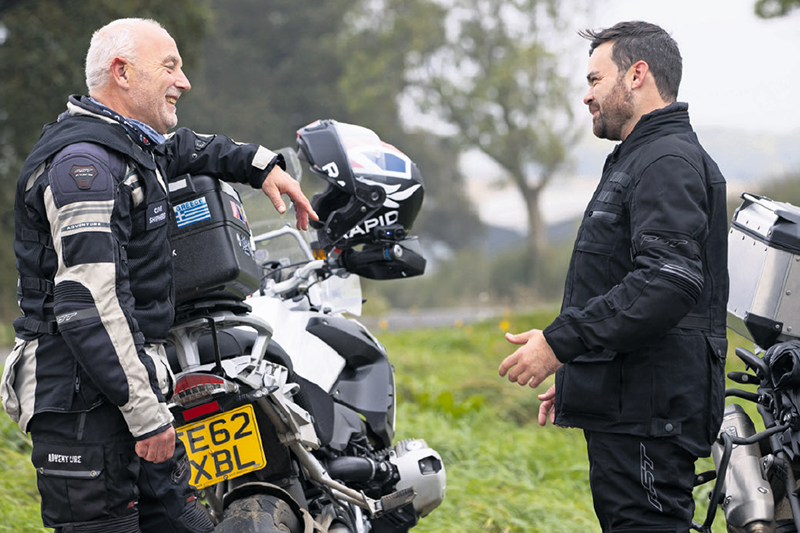
Martin Brennan with his Rapid Pro Coach Clive Shepherd.
1. Looking further ahead
When I started I was really worried about what was two feet in front of me – the road surface, the verge, whether there was diesel. It meant I was hardly looking ahead at all and wasn’t spotting things like upcoming corners, junctions or traffic. It sounds obvious now, but knowing what’s up the road makes a massive difference. When I started looking across fields to see where the road went, or noticing junctions half a mile away, I could start deciding what to do rather than being surprised. Even things like road signs can be really useful, but I wasn’t noticing them at the start. You have an intercom earpiece, so Clive [Martin’s Rapid Training coach] was saying things like ‘did you see the white van half a mile up the road’ and I wouldn’t have. It took me a while to get into this and it was only later in the course that I was doing it all the time. The trick is to look ahead and use peripheral vision to see what’s just in front.
2. Positioning for the view
At the start I was riding like I was taught for my test [which Martin passed two years ago], so I was sticking in the middle of the lane and not going anywhere near the edges. But by staying on the left for right hand corners and moving to the right for left handers you get a much earlier view of the road. I’d read about the technique but wasn’t convinced it would make that much difference but it definitely does. It makes a massive difference.
Also, it means others can see you earlier too – there were a couple of instances in town where a car could see me, but if I was positioned where I used to be, they wouldn’t have.
I found it easy to use the technique on left hand turns because it feels like there’s plenty of room for error. But on right handers, when I needed to be closer to the verge, I found it difficult – I couldn’t help focusing on the verge rather than looking ahead. But as I grew in confidence about what the bike could do I slowly realised it was ok to stay there round the corner.
3. Being in the right place for overtakes
I was just overtaking like I do in a car – come up behind, peer round the vehicle in front and then overtake. But on a straight, if it’s clear you can move out to the right far earlier and see what’s coming, and if it’s clear you can overtake. There’s no need to get close to the vehicle in front, because then you can’t see if it’s clear.
Also, I wasn’t using right hand corners as a chance to overtake. If you hang back as you go round the corner, then close in on the rear right hand corner of the car as the bend starts to open up, you can get a view down the next stretch of road. If there’s nothing coming you can just be off. It took me a while to get that – it was easy to understand but I found it hard to put into practice because you need to recognise when the right hand bend is going to open up. I was hanging back a little bit too much, which made it harder work.
4. Trusting the tyres
The days on track were brilliant at getting me to trust the bike and the tyres. Obviously I’ve seen pictures of riders really leaning bikes over, so I knew it was possible but until I’d experienced it on track I didn’t believe it was possible for me. My confidence went up a lot, knowing that the bike and tyres can do it – and probably with plenty in reserve. On the second track day I progressed even further – my cornering improved massively. I felt like I was more active on the bike, giving it a shove on the bars to get it to turn quicker, and then getting on the throttle harder out of the corner. Before I was worried that the rear tyre would lose grip, but the track taught me that there is a lot of grip there.
Back on the road, I felt much more confident in corners, particularly driving out of them using the slow in, fast out method. And I had more confidence in the wet too. I loved my time on track so much. It was brilliant fun and I am definitely going to do another trackday.
5. Using positive steering
I was a bit lazy with steering and not very active with the way I turned the bike into corners, and then I was fidgeting with the steering, correcting and adjusting all the way round – I was never sure what I was meant to be doing. It was really useful on the track practicing giving the inside bar a single push to get the bike onto the line you want, and then just leaving it. You can then relax because it just stays there, going round, doing its thing. On the second trackday I learned about giving the inside bar a quicker push to get it to lean faster, and that was brilliant. It meant I could give it a shove, get the bike turned quickly and then blast out. I loved that.
6. Body position
I know I’ve always tended to fight the lean of the bike by leaning out of corners with my upper body. Just concentrating on leaning left when I turned left helped my confidence a lot. I felt more comfortable on the bike.
7. Practice braking
One of my bad traits was braking several times approaching a corner. I’d brake, realise I hadn’t braked enough, then do a bit more. I learned that if I came off the throttle at the right place, I went into the corner at the right speed, so usually I didn’t need any braking at all unless I planned to.
I also used to do a lot of comfort braking in corners whenever I didn’t feel comfortable with my speed. As my cornering confidence grew, all that stopped.
Also, to start with I was using front and back brakes together, sometimes locking up the back. But using just the front brake for everything above a walking pace makes things so much simpler. And on track I realised how fast the front brakes can stop you, which gave me a lot of confidence.

Instructor’s verdict:
Clive Shepherd was Martin’s Rapid coach. He had this to say.
“The moment when it all came together for Martin was on day five after he’d ridden really well for an hour or so and he said ‘I think this is the first time I’ve really looked far ahead.’ That’s when it seemed to have clicked, and I could see it in his riding.
“Reading the road, planning, machine control, cornering and overtaking are the big areas for better riding and he’s not only grasped the basic principles he's taken them up a level or three. His confidence, focus and smoothness have dramatically improved, he’s a lot more precise than he was thanks to the track training, and he’s now impressively progressive, safe and smooth.
"To have turned his level of riding round from post-test novice to fast, flowing and fluid during eight days coaching over the course of three months is a real achievement. He’s done really well and is living proof that it's not miles in the saddle that make us better riders, it’s skills development and supportive coaching that will do it every time.”
Find out more about our Bikemaster course or if you would like to enquire or book click here